Foundation guide
How Deep Do Foundation Piers Go in San Antonio?
Our piers go all the way down to bedrock. How far that is depends on your lot, and it can change from one corner of the house to the next. Here is how it works.
It is one of the most common questions at the kitchen table: how deep will the piers go? It is a good question, because a pier is only as good as what it stands on. A pier that stops in the clay is still riding on the soil that moved the house in the first place.
The short answer: on a We Level Homes job, every steel and concrete pier is pressed down until it stops on bedrock at 10,000 psi. The depth is whatever it takes to get there. This guide explains why that depth varies so much across San Antonio and how we know each pier has reached it.
Want to know what is going on under your house?
Matt will measure it for free and show you what he finds. No pressure, no phone guesses.
Why Piers Need to Reach Bedrock
Much of San Antonio sits on expansive clay that shrinks in hot, dry summers and swells when the rain comes back. A house sitting on that clay rides up and down with it. The point of a pier is to stop depending on that clay and carry the weight of the house down to ground that doesn’t move with the weather.
Bedrock is that ground. It doesn’t shrink and swell the way clay does. A pier that stands on it holds the house where it is put, no matter what the clay around it does next summer.
That is the whole reason depth matters. A pier that stops partway down, still in the clay, is resting on soil that gets wetter and drier with the seasons. It may hold for a while, but it is still exposed to the same movement that dropped the house. Reaching bedrock takes the clay out of the picture under that part of the house.
Why There Is No Single Depth
The ground under San Antonio changes a lot from one side of the city to the other. The city sits where the Hill Country meets the flatter land to the south and east, and the rock under it is closer to the surface in some places than others.
| Part of town | What is usually underground | What it means for pier depth |
|---|---|---|
| North of Loop 1604 / Hill Country edge | Limestone often only a few feet down | Piers are often short |
| East and south sides | Clay that can run much deeper | Piers often go further down |
| Central areas | Varies by neighborhood and lot | Depth found as each pier is pressed |
These are general patterns, not rules. Two houses on the same street can have rock at different depths, and so can two corners of the same house.
Even on one lot, the depth can change. A house on a hillside might have rock close to the surface at the uphill corner and deeper clay or fill at the downhill corner. That is why each pier is pressed on its own until it stops.
How a Pressed Pier Finds Bedrock
Pressed piers aren’t dug to a set depth and filled. They are pushed into the ground one section at a time with a hydraulic jack, using the weight of the house above as the thing the jack pushes against.
- The crew digs a hole beside or under the foundation at the spot that needs support.
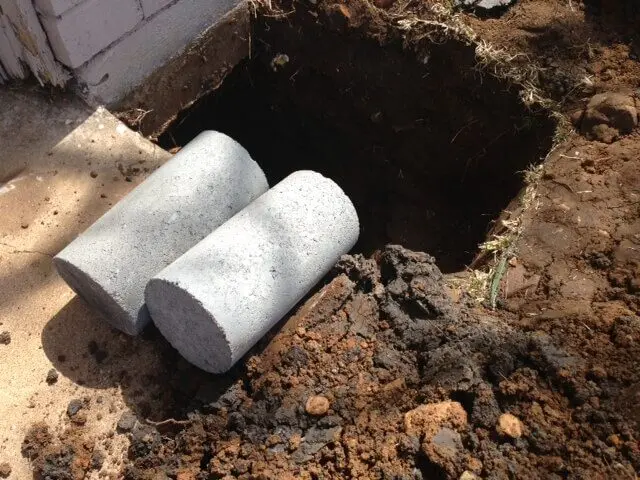
- The first section, a concrete cylinder or a steel section, is set in the hole under the foundation.
- The jack presses it into the ground. As it sinks, the next section goes on top.
- Section after section goes down until the pier stops moving on bedrock and the gauge reads 10,000 psi.
- A cap goes on top, and the house is lifted and set on the pier.
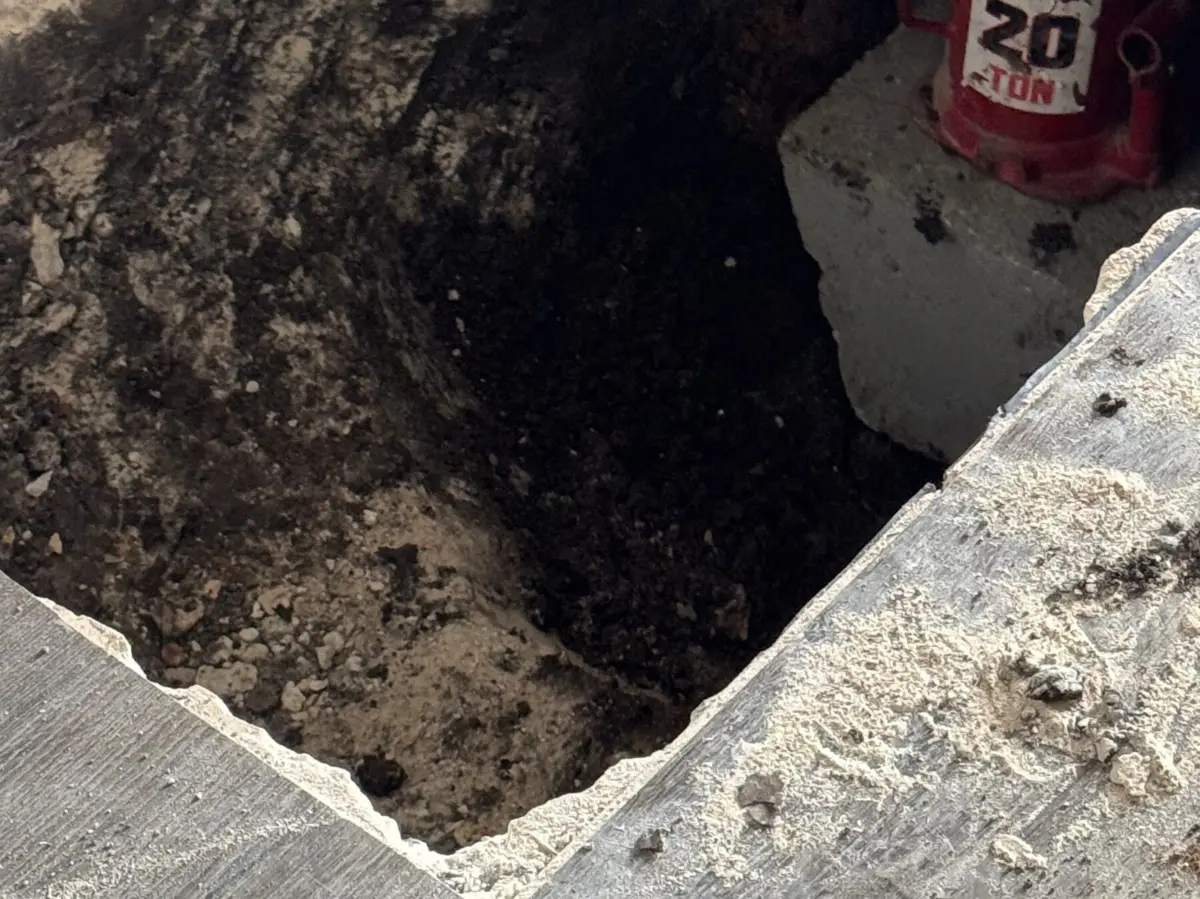
Because the pier is pressed until it stops, the ground decides the depth, not a number on a plan. A pier on shallow rock may stop after a few sections. A pier in deep clay keeps going until it reaches rock.
Using the house as the counterweight has a side benefit: each pier is loaded with real weight from the start. The crew isn’t guessing whether the ground below can carry the house. The house itself is pushing the pier down, and it stops only when the ground can take that push.
What 10,000 PSI Tells You
The hydraulic jack has a pressure gauge. As the pier goes down through clay, it moves fairly easily. When it hits bedrock, it stops, and the pressure climbs. Pressing each pier to 10,000 psi means each one has been loaded hard before the house is ever set on it.
In plain terms: the pier has been tested in place. If it can take that pressure without moving, it is standing on something solid.
It also means the depth on your house isn’t a guess written into a plan before anyone digs. The gauge, not an estimate, tells the crew when a pier has reached bedrock. That is the same on a short pier north of Loop 1604 and a long one on the east side.
Exterior and Interior Piers
Piers go where the house dropped. Often that is along the outside edge, where the crew digs beside the foundation and presses the pier under the grade beam. Our article on exterior piers along the grade beam shows how that works.
When the middle of the slab has dropped, piers go in from inside the house. The crew opens a section of the floor, digs down, presses the pier to bedrock the same way, and patches the opening afterward. The depth rule doesn’t change: an interior pier is pressed until it stops on bedrock at 10,000 psi, just like an exterior one.
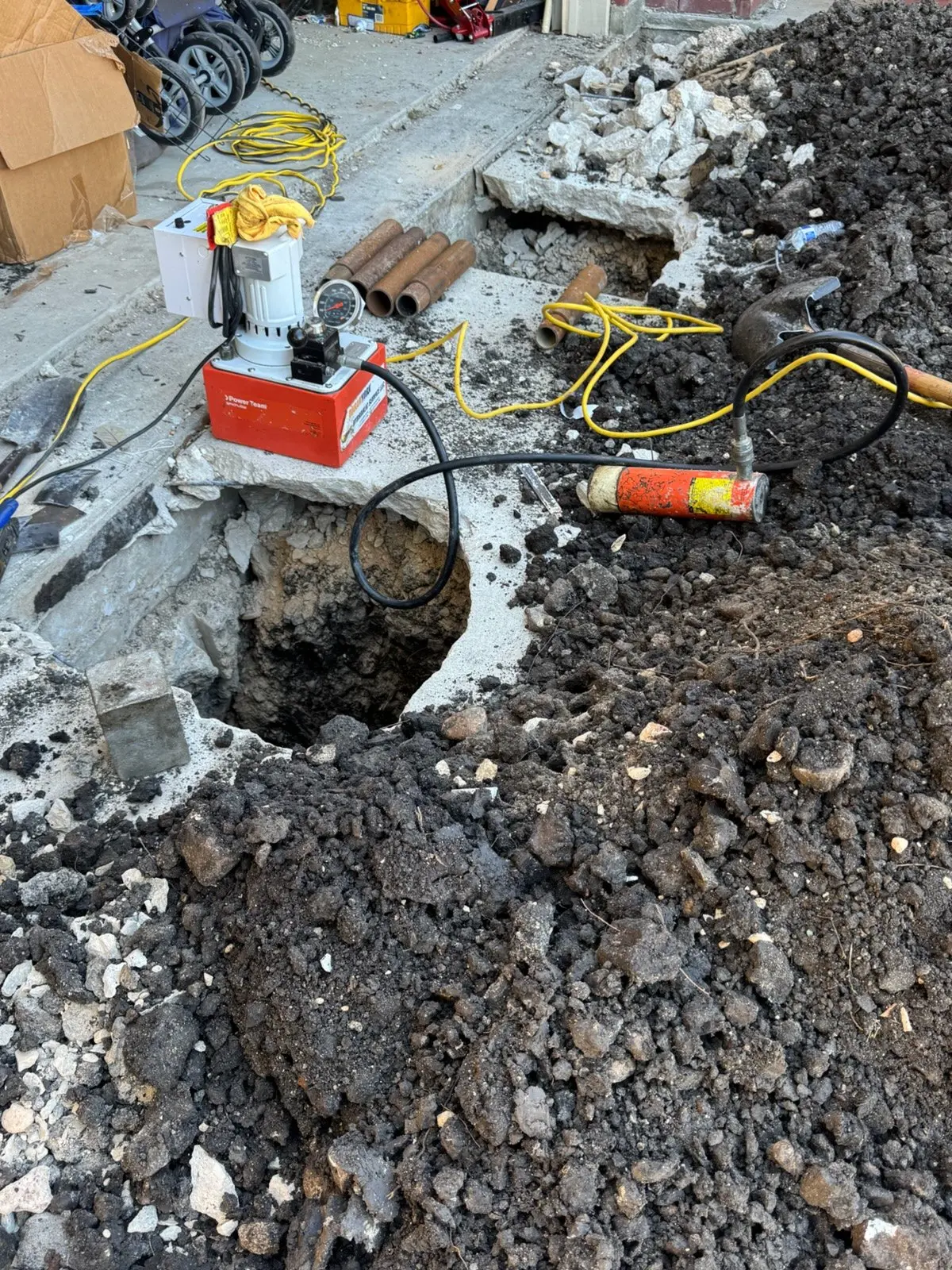
Access does change the work. A pier under a patio, a driveway edge, or a tiled kitchen floor takes more effort to reach than one beside an open flower bed. That, along with depth, is part of what Matt looks at when he prices the job.
Concrete and Steel Piers Reach the Same Ground
A common belief is that steel piers go deeper than concrete piers. On our jobs, they don’t. Concrete piers are stacks of solid reinforced concrete cylinders with a cap block on top. Steel piers are steel sections that interlock into one solid steel pier. Both are pressed until they stop on bedrock at 10,000 psi.
The differences are the material, the warranty (lifetime on steel, 25 years on concrete), and the price. Our concrete vs. steel pier comparison goes through how to choose.
Why Depth Affects the Price
Every section that goes into the ground is material and labor. A pier that stops on shallow rock uses fewer sections than one that goes down through deep clay. Since nobody knows exactly how deep the rock is under each corner until the pier is pressed, nobody can give you an honest per-pier price over the phone.
What Matt can do is look at your house and lot, tell you what he expects based on the area, and give you an exact written price. Our answer on pricing over the phone explains why we work that way.
What You Get at the End
When the job is done, you get your warranty in writing along with a drawing that shows where each pier went. Every repair is certified by a licensed structural engineer, and permits are pulled when the city requires them. Our warranty page explains the coverage.
Keep that drawing with your house papers. If you ever sell, it shows a buyer exactly where the support went. Pressed steel and concrete piers are slab repairs; a pier and beam home gets new poured concrete piers in place of rotten or sunken wood posts, and a manufactured home gets new piers under its frame. Matt will explain what your house type needs.
Related questions
Can you tell me how deep my piers will go before the job?
Matt can tell you what to expect for your part of town, but the exact depth isn’t known until each pier is pressed and stops on bedrock.
Do all the piers on my house go to the same depth?
Not always. Rock can sit at different depths under different corners, so each pier is pressed until it stops on its own.
Is a deeper pier a better pier?
Not by itself. What matters is that the pier stops on bedrock at 10,000 psi. A short pier on shallow rock is doing the same job as a long one in deep clay.
Why not just dig down until you hit rock?
Pressing the pier tests it as it goes. Each one is loaded to 10,000 psi before the house is set on it, so you know it is holding.
Written by Matthew Zeman, co-owner of We Level Homes, with almost 20 years in foundation repair. Last updated November 18, 2026.