Foundation guide
Piers, Pads, and Blocks: What Holds Up a Manufactured Home
Most owners never see what is under their home until something goes wrong. Here is what holds a manufactured home up, part by part, and where trouble usually starts.
Lift a skirting panel on most manufactured homes and you will see a long steel frame running the length of the home, with short columns under it every so often. Those columns are the piers. They sit on pads, which sit on the ground. That is the whole support system for many homes, and when any one piece of it slips, the home goes out of level.
This guide explains each part in plain words, how the parts work together, and what tends to fail in South Texas. If you already know your home has a problem, our manufactured home foundation repair page explains how we fix it.
Want to know what is going on under your house?
Matt will measure it for free and show you what he finds. No pressure, no phone guesses.
The Steel Frame: What Everything Rests On
A manufactured home is built on a steel chassis, usually two long steel I-beams running front to back with cross members between them. The floor of the home is built on top of that frame. When the home was delivered, the frame carried it down the road on its axles and wheels. Once it was set, the wheels usually came off and the frame was set down on piers.
That frame is the key to how a manufactured home is supported. The piers push up on the frame, not on the floor. If the frame is well supported along its length, the floor above it stays flat. If one spot loses support, the frame can sag there, and the floor sags with it.
Piers: The Columns Under the Frame
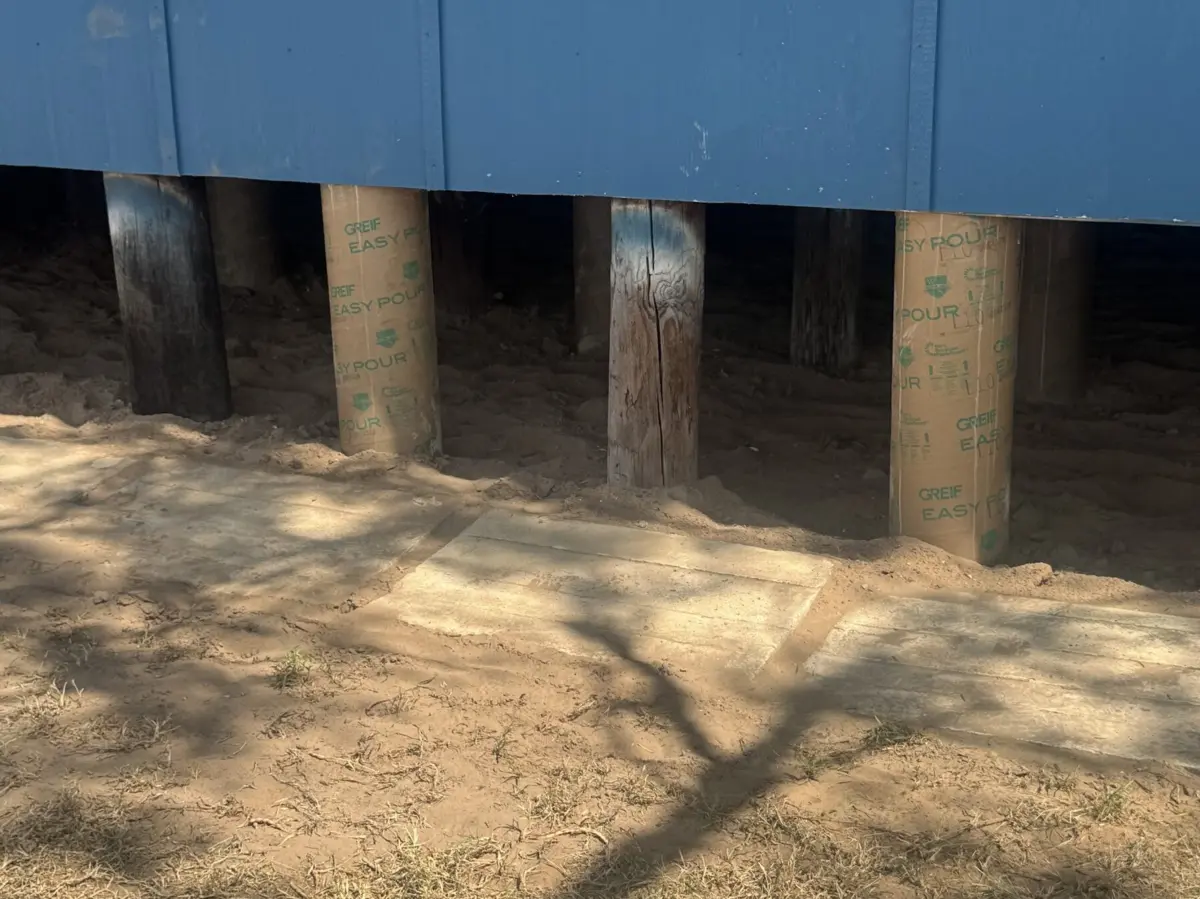
Piers are the short columns between the ground and the frame. On many older homes they are dry-stacked concrete blocks, set with their hollow cores running up and down, without mortar. Some homes have steel stands. Others have poured or precast concrete piers.
Piers are usually spaced at intervals along each I-beam, with extra piers at points that carry more weight, like the ends of the home, beside large door openings, and along the marriage line of a double-wide. The exact layout depends on the home and how it was set.
Pads: What the Piers Sit On
A pier is only as steady as what is under it. That is the job of the pad, sometimes called a footing. Pads spread the weight of each pier over a wider patch of ground so it doesn’t push straight down into the soil.
- Plastic (ABS) pads. Lightweight pads that sit on the ground surface. They are common on many homes.
- Precast concrete pads. Small concrete slabs set under each pier.
- Poured concrete footings or runners. Concrete poured in the ground under the pier line.
When a pad sits on soft or shifting soil, it can tip, crack, or sink, and the pier on top of it goes with it. In San Antonio clay, that happens more often than most owners expect.
Blocks, Caps, Shims, and Wedges
Between the top of the pier and the frame, there are usually a few smaller pieces that take up the last bit of space.
- Cap blocks. Solid blocks on top of the pier that spread the load before it reaches the frame.
- Shims and wedges. Thin pieces of hardwood or steel driven in to snug the frame down onto the pier.
Shims are where many homes slowly lose their level. Wood shims can dry out, split, or rot over the years. When a shim loosens, that pier stops carrying its share, and the load moves to the piers beside it.
Anchors and Tie-Downs
Most manufactured homes also have anchors in the ground with straps running to the frame. Their job is to hold the home down in high wind. They are a separate system from the piers. Piers hold the home up; anchors hold it down.
We don’t install anchors or tie-downs. If Matt sees straps that look loose or damaged while he is under the home, he will point them out so you can have them looked at.
How the Parts Work Together
| Part | What it does | What often goes wrong |
|---|---|---|
| Steel frame | Carries the floor and the home above it | Sags between piers when one loses support |
| Piers | Hold the frame up at set spots | Lean, sink, or shift off their pads |
| Pads | Spread each pier’s load over the soil | Tip, crack, or sink in soft or wet clay |
| Cap blocks | Spread the load into the frame | Crack or slip |
| Shims and wedges | Snug the frame onto the pier | Dry out, split, rot, or work loose |
| Anchors and straps | Hold the home down in wind | Loosen or rust (a separate system from the piers) |
A home can be out of level from any one of these, or from several at once. That is why Matt goes under the home before giving a price.
Why Piers and Pads Fail in South Texas
Much of San Antonio sits on expansive clay. It shrinks and cracks in hot, dry summers, then swells when heavy rain comes. A pad sitting near the surface rides up and down with that cycle. Over the years, some pads end up a little lower than others, and the home goes out of level.
Water makes it worse. Gutter runoff, a low spot in the yard, or a leaking line under the home can soften the soil under a few piers. North of Loop 1604, rock is often closer to the surface, while on the east and south sides of town the clay can run deeper. You can read more in why manufactured homes settle.
What We Do When Piers Fail
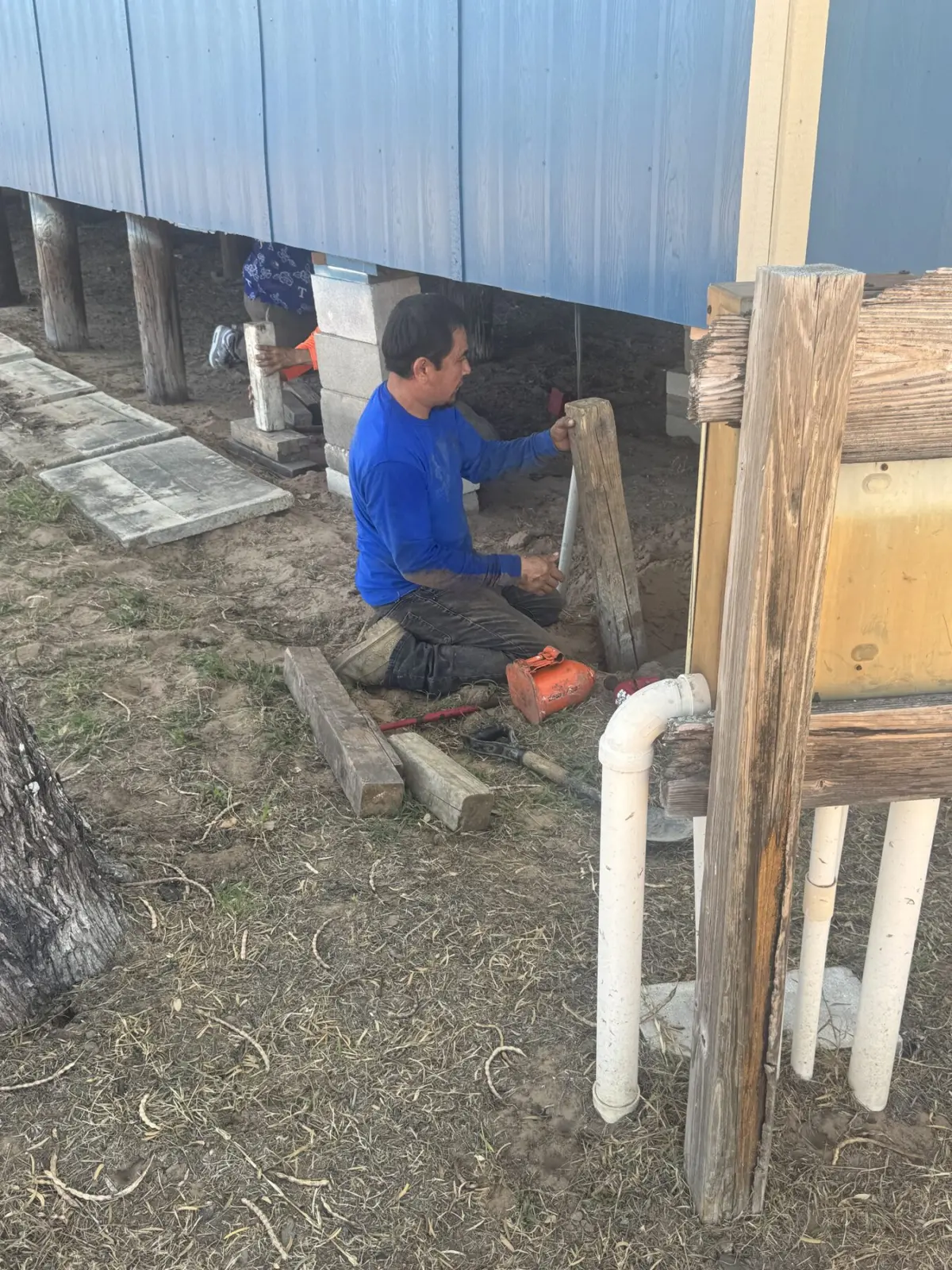
When the piers under a home have sunk, tipped, or broken down, the fix is new piers under the frame and the home brought back to level. Matt goes under the home, measures how far out it is, and decides where new piers need to go. On repair day the crew sets them, lifts the frame carefully, and brings the home back to level on solid support.
Every repair is certified by a licensed structural engineer, and we pull permits when they are required. You get an exact written price before any work starts. We don’t pour new pads, convert homes to a permanent foundation, or install tie-downs; Matt will tell you if he thinks your home needs something outside what we do.
How Many Piers Does a Home Need?
There is no single number. The layout depends on the size and weight of the home, how long its frame is, whether it is a single-wide or a double-wide, and where the heavy spots are. A double-wide also needs support along the marriage line where the two halves meet. We explain more in double-wide vs. single-wide leveling.
What matters on a repair is not the total count but whether each part of the frame that dropped has solid support under it. Matt will show you where new piers would go and why each one is there.
Signs a Pier Has Failed
You will usually feel a failed pier inside before you see it. Doors start to stick, floors slope toward one spot, and ceiling seams open. Our guide to signs your manufactured home is out of level covers those. If you can see under the home through a vent, look for:
- Block piers leaning or bowed out of line with the frame.
- Cracked or crumbling blocks.
- Pads tipped on one edge, or sunk below the soil around them.
- A visible gap between the top of a pier and the frame.
- Shims that are split, rotted, or lying on the ground.
Look from the outside only. Please don’t crawl under the home or try to reset a pier yourself. See can I level my mobile home myself.
Questions to Ask About Your Home’s Support
- What are the piers under my home made of, and what do they sit on?
- Are any of them leaning, cracked, or off their pads?
- Are the shims tight, or have some worked loose?
- Is water collecting under the home?
- Where would new piers go, and why there?
- Is the repair certified by a licensed structural engineer?
Related questions
Are concrete blocks a normal way to hold up a manufactured home?
Yes. Dry-stacked concrete block piers are common, especially on older homes. They work when they sit on a solid pad and are kept tight to the frame.
What is the difference between a pier and an anchor?
Piers hold the home up. Anchors and straps hold it down in high wind. They are separate systems.
Do you just add shims to fix a home?
Not when the piers themselves have failed. Our repair is new piers under the frame and the home brought back to level. Matt explains what your home needs.
Will you show me what is under my home?
Yes. Matt goes under the home during the free inspection and shows you photos of what he finds.
Written by Matthew Zeman, co-owner of We Level Homes, with almost 20 years in foundation repair. Last updated November 18, 2026.