Quick answer
How Often Should a Pier and Beam House Be Re-Leveled?
You may have heard a rule of thumb. There isn’t a reliable one. Here is what actually decides how long a leveled raised home stays that way.
Short answer
There is no fixed schedule. Some pier and beam houses stay level for many years after a good repair, and others need an adjustment sooner. It depends on what the beams rest on, how much the clay under the house moves, and how well water is kept away. Re-level when the signs come back, not by the calendar.
Why There Is No Set Schedule
You will hear people say a raised house needs to be re-leveled every so many years. The trouble is that houses don’t follow a calendar. Two homes on the same street, leveled the same week, can behave very differently afterward.
What matters is what changed under the house, not how much time has passed. That is why we would rather tell you what to watch for than give you a number.
What Decides How Long It Lasts
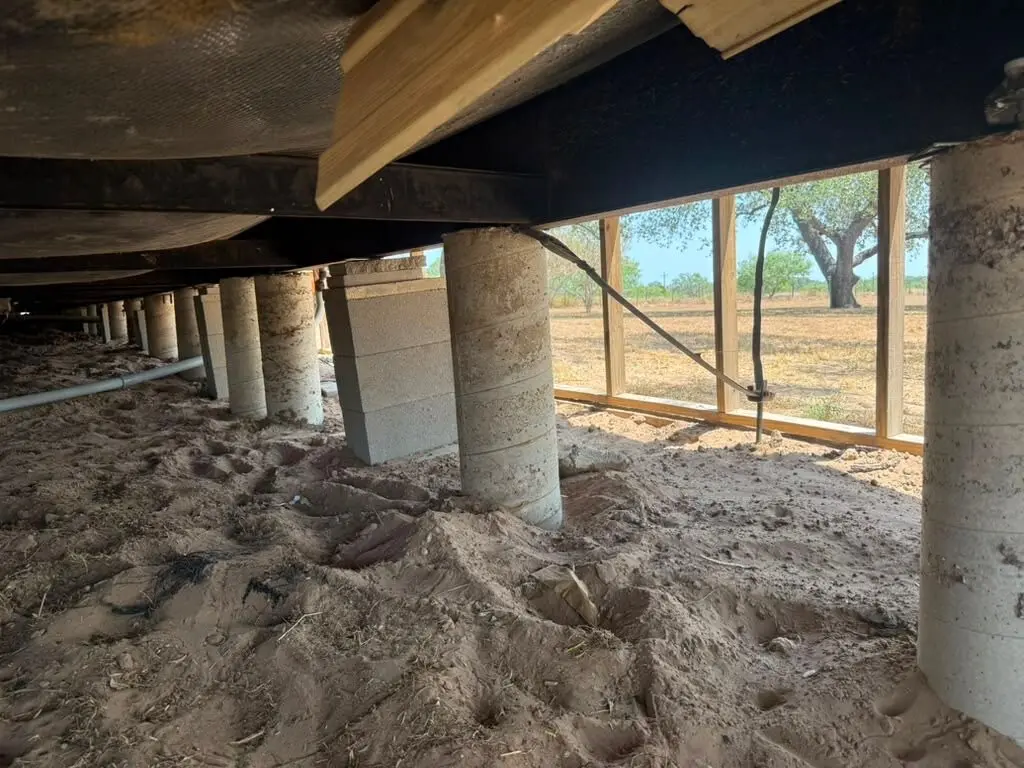
- What the beams rest on. A house shimmed on top of the same old wood posts that failed tends to drop again as those posts keep rotting or sinking. A house where the failed posts were replaced with poured concrete piers is resting on supports that won’t rot.
- How much the clay moves. Much of San Antonio sits on expansive clay that shrinks in long, dry summers and swells after heavy rain. The more the soil under a house swings, the more the supports can move with it.
- Water around the house. Downspouts emptying next to the foundation, soil sloping toward the house, or a plumbing leak underneath can keep one area wet and soft.
- Trees. Large trees close to the house can dry out the clay on one side during a drought. See trees, roots, and your foundation.
- How far the house was lifted. A house that had sagged for decades can settle in a little as it adjusts to its new position.
- Changes inside. A heavy remodel, like a tile floor or a stone countertop, adds load to the supports under it.
Signs It May Be Time
Instead of a schedule, watch for the house to tell you:
- Doors that worked after the last leveling start to stick again.
- New dips or a slope you didn’t notice before.
- Cracks at door and window corners that open up again after being patched.
- Floors that feel bouncy or soft in a new spot.
- Gaps showing up at baseboards or trim.
A door that sticks in August and works fine in spring may be the clay moving with the season rather than the house dropping. Note when things change, and take dated photos. Our article on weather and foundation movement explains the seasonal pattern.
How to Make Leveling Last Longer
- Fix the supports, not just the height. Replacing rotted or sunken posts with concrete piers before shimming is the biggest single thing. Our guide to shimming and re-leveling explains why.
- Keep water moving away. Clean gutters, downspouts that empty away from the house, and soil that slopes away from the foundation.
- Fix leaks quickly. A plumber should handle any leak under the house. Many pre-1980s homes have cast iron drain lines that can crack with age.
- Keep up with termite inspections through a licensed pest control company.
- Add drainage with a larger repair if water is a real problem. We add drainage only as part of a larger foundation repair.
The Upside of a Raised Home
One good thing about pier and beam is that the beams can be reached and adjusted again if the house moves later. That is much harder on a slab. If your floors start to feel different, call or text (210) 934-6066 for a free inspection. Matt will measure, go underneath, and tell you whether it needs an adjustment or is moving with the season. For how our written warranties work, see our warranty page.
Related questions
Is it normal for a house to settle a little after leveling?
It can be, especially in an older house that had sagged for a long time. Matt will tell you what to expect for your house before the job.
Does replacing posts with concrete piers mean I never need to re-level?
It means the supports won’t rot. The house still sits on soil that moves, so an adjustment later is possible, depending on the soil and water around it.
Should I re-level before selling?
It depends on the house and the market. Ask your real estate agent, and see our answer on leveling before you sell.
Can you check a house you leveled before?
Yes. Call or text (210) 934-6066 and Matt will come take a look.
Written by Matthew Zeman, co-owner of We Level Homes, with almost 20 years in foundation repair. Last updated November 18, 2026.