Foundation guide
Foundation Settling vs. Foundation Failure: How to Tell
Every house settles some. The question is whether yours settled and stopped, or is still moving one part of the house away from the rest. Here is how to tell the two apart.
“Houses settle” is something people hear a lot, often from a seller or a neighbor. It is true. It is also not the whole story. Some settling is normal and harmless. Some is the early stage of a foundation that keeps moving and needs repair.
“Failure” sounds dramatic, but in foundation repair it usually just means the foundation is no longer holding the house level and stable, so one part is moving more than the rest. It rarely means anything sudden. This guide explains the difference and how to keep track of what your house is doing.
Want to know what is going on under your house?
Matt will measure it for free and show you what he finds. No pressure, no phone guesses.
What Normal Settling Looks Like
When a house is built, the soil under it compresses a little under the new weight, and the concrete and framing shrink as they dry. That causes small, even movement in the first years. Some seasonal movement on clay is normal too.
- Thin hairline cracks in the slab that don’t grow.
- Small cracks along sheetrock seams, often in the first few years.
- A door that needs a hinge adjustment once.
- Movement that is about the same all over the house, not in one corner.
- Cracks that appear, then stay the same size year after year.
The key word is “stopped.” Normal settling happens, and then it is done or stays small.
Older homes are a special case. A house built decades ago has had a long time to move, and a little slope in an old floor isn’t always a sign of anything happening now. The question for an older home is the same one: is it still changing? A floor that has sloped the same way for decades is different from one that has gotten worse since last summer. Our guide to leveling older San Antonio homes covers what to expect.
What Ongoing Movement Looks Like
A foundation that needs repair keeps moving, and usually moves unevenly. One corner or one side drops further than the rest, and the signs gather there.
- Cracks that get wider over time, or come back after they are patched.
- Diagonal cracks at door and window corners, and stair-step cracks in brick.
- Slab or tile cracks where one side sits higher than the other.
- Several doors sticking in the same part of the house.
- Floors you can feel sloping, or that a marble rolls across.
- Gaps at windows, brick corners, baseboards, or the roofline.
Side by Side
| Normal settling | Movement that needs repair | |
|---|---|---|
| Pattern | Even across the house | Concentrated in one area or side |
| Cracks | Thin, stable, flat on both sides | Growing, recurring, or offset |
| Doors | Maybe one, fixed with a hinge adjustment | Several, in the same part of the house |
| Floors | Feel flat | Slope you can feel or measure |
| Over time | Stays the same | Gets worse, often in dry summers |
One sign rarely decides it. A pattern of signs in the same area, getting worse over time, is what points to repair.
Settling, Heave, and Seasonal Swings
Not all movement is downward. In San Antonio clay, part of a slab can be pushed up when wet clay swells, which is called heave. A house can also move a little up and down with the seasons without getting steadily worse.
That makes timing matter. A crack in August might look much worse than the same crack in April. Track it across seasons before deciding it is growing. Our article on slab settlement vs. heave explains how each one shows up, and it is worth keeping the seasons in mind whenever you compare photos.
How to Track Your House Yourself
- Mark your cracks. Put a pencil mark at each end, write the date, and photograph it with a coin or tape measure beside it.
- Note your doors. Write down which doors stick and where they rub.
- Check the floors. A marble or a long level on a hard floor shows obvious slopes.
- Look again each season. Compare your photos in spring and late summer.
- Watch for clusters. Several signs gathering in one part of the house matter more than one sign anywhere.
This won’t give you exact numbers, but it gives you a history. That history helps anyone measuring your house later.
When to Have It Measured
You don’t need to wait for a pile of evidence. These are good reasons to have the house measured instead of watching it alone:
- A crack you can fit a coin in, or any crack where one side sits higher than the other.
- A crack that came back after it was patched.
- Several signs in one area, such as a sticking door, a diagonal crack, and a gap at a window all on the same side of the house.
- A floor that feels like it slopes, especially if it is new.
- You are buying or selling and want to know where the house stands.
- A known plumbing leak under the slab, now or in the past.
Measuring early doesn’t commit you to anything. It gives you a baseline, and if Matt finds nothing that needs repair, you have that answer in hand.
It also helps to know what a measurement can and can’t tell you. One set of level readings shows where the house sits today, not how fast it is moving. That is why your own crack photos and notes are useful: put next to the readings, they show both where the house is low and whether it has been changing.
How a Professional Tells the Difference
Eyes and photos only go so far. The clearest answer comes from measuring. Matt takes level readings across the whole house, room by room, and maps which parts are higher and lower. Our article on floor elevation surveys shows how that works.
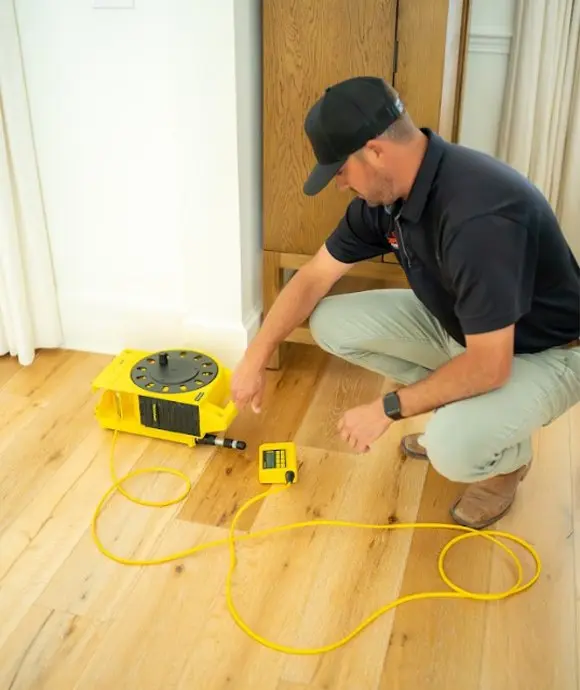
Even and small differences usually mean settling. A clear low area that matches the cracks and sticking doors usually means movement that needs repair. If the house is fine, Matt tells you. If it needs work, he shows you where and why, with an exact written price.
He also asks about the things that keep a house moving: plumbing leaks, big trees near the house, and where water goes when it rains. Our guide to what causes foundation problems in San Antonio walks through each one. If something like a leak is part of the picture, it needs to be dealt with too, or the soil under that spot keeps changing.
Does Waiting Make It Worse?
Ongoing movement tends to keep going, because the cause is usually still there: clay that shrinks and swells, a leak, or a tree drying the soil. Cracks get wider, more doors stick, and sometimes more piers are needed to reach the area that moved. That is not a reason to panic. It is a reason to have it measured so you know where you stand. Our answer on whether foundation problems get worse goes through it.
What Repair Looks Like When It’s Needed
When a part of the house has dropped, steel or concrete piers are pressed down under that area until they stop on bedrock at 10,000 psi, and the house is lifted back toward level. A licensed structural engineer certifies every repair. Steel piers carry a lifetime warranty and concrete piers carry a 25-year warranty, in writing, with a drawing of where each pier went.
On a pier and beam home, the repair looks different: rotten or sunken wood posts come out, poured concrete piers go in, and the beams are shimmed back to level. On a manufactured home, new piers go under the frame and the home is brought back to level.
Either way, the goal is a house that is level and stable, not just level for now. Our article on level vs. stable explains why those are two different promises.
Related questions
Is it normal for a new house to settle?
Some settling and a few hairline cracks are common in a new home. Movement that keeps growing, or gathers in one corner, is worth having measured.
Can a foundation settle and then stop?
Yes. Plenty of houses settle a little and stay that way for years. Tracking cracks across seasons helps show whether yours has stopped.
Does failure mean my house is unsafe?
Usually not. In foundation repair it mostly means part of the house is moving more than the rest. If you ever see something that worries you about safety, call a professional right away.
What if the inspection says it is just settling?
Then Matt will tell you that, and you don’t need piers. Keep tracking your cracks so you can see if anything changes.
Written by Matthew Zeman, co-owner of We Level Homes, with almost 20 years in foundation repair. Last updated November 18, 2026.